
Why has my lawn gone patchy?
Author: Stefan Palm Date Posted: 18 February 2026
The most common cause of patchy lawns in summer is moisture stressrather than beetles or disease. Learn how to identify under-watering and non-wetting soil, and fix the issue with simple watering checks and wetting agents.
Summary
Across South Australia each summer, we see a wave of lawns that suddenly look tired, patchy, and thin. By far the most common reason for this at this time of year is moisture stress—your lawn simply isn’t able to draw enough water from the soil to stay healthy.
This type of patchiness is often mistaken for beetle damage or disease, but in the vast majority of cases, it comes back to moisture. Once you understand what’s really going on beneath the surface, the fix is usually straightforward.
In most situations, moisture stress is caused by one of two things: either the lawn isn’t being watered enough (or evenly), or the soil underneath has become water-repellent and won’t allow moisture to penetrate.
Why this is so common in Adelaide
Adelaide’s summer conditions are hard on lawns. Long stretches of hot, dry weather, low humidity, and minimal rainfall mean soil dries out quickly and stays dry. It’s not unusual to have extended runs of 30–40°C days with very little natural rainfall to support lawns.
When our soils dry down to that point, many of them actually become difficult to re-wet. That’s why lawns can deteriorate quickly at this time of year—even when you feel like you’ve been watering.
The real issue: moisture stress
When a lawn can’t access enough moisture through its roots, it begins to shut down. Colour fades, growth slows, and before long you start to see dry patches appearing through the lawn.
From the hundreds of lawn samples and on-site inspections we’ve done over the years, moisture stress is the leading cause of summer lawn decline in South Australia—well ahead of pests and disease.
There are two main reasons why it happens.
1) Not enough water (or not applied evenly)
A lot of people are surprised to learn they’re simply not applying as much water as they think they are.
During summer, couch (bermuda) and kikuyu lawns generally need around 25mm of water per week to stay green and perform well. They’ll survive on less, but they won’t look their best.
The key isn’t just the total amount of water, it’s also how evenly it’s applied. You can have one section of lawn getting plenty while another area only receives a fraction of that.
The most reliable way to check this is by using catch cups (small rain-gauge style containers). Place them across your lawn, run your sprinklers as you normally would, and then measure what you collected. It’s very common to discover that the areas going brown are the ones receiving the least water.
Once you can see what’s actually happening, adjusting your watering schedule or sprinkler layout usually solves the problem quickly.
2) Non-wetting soil (the hidden problem)
This is the one that catches most people out.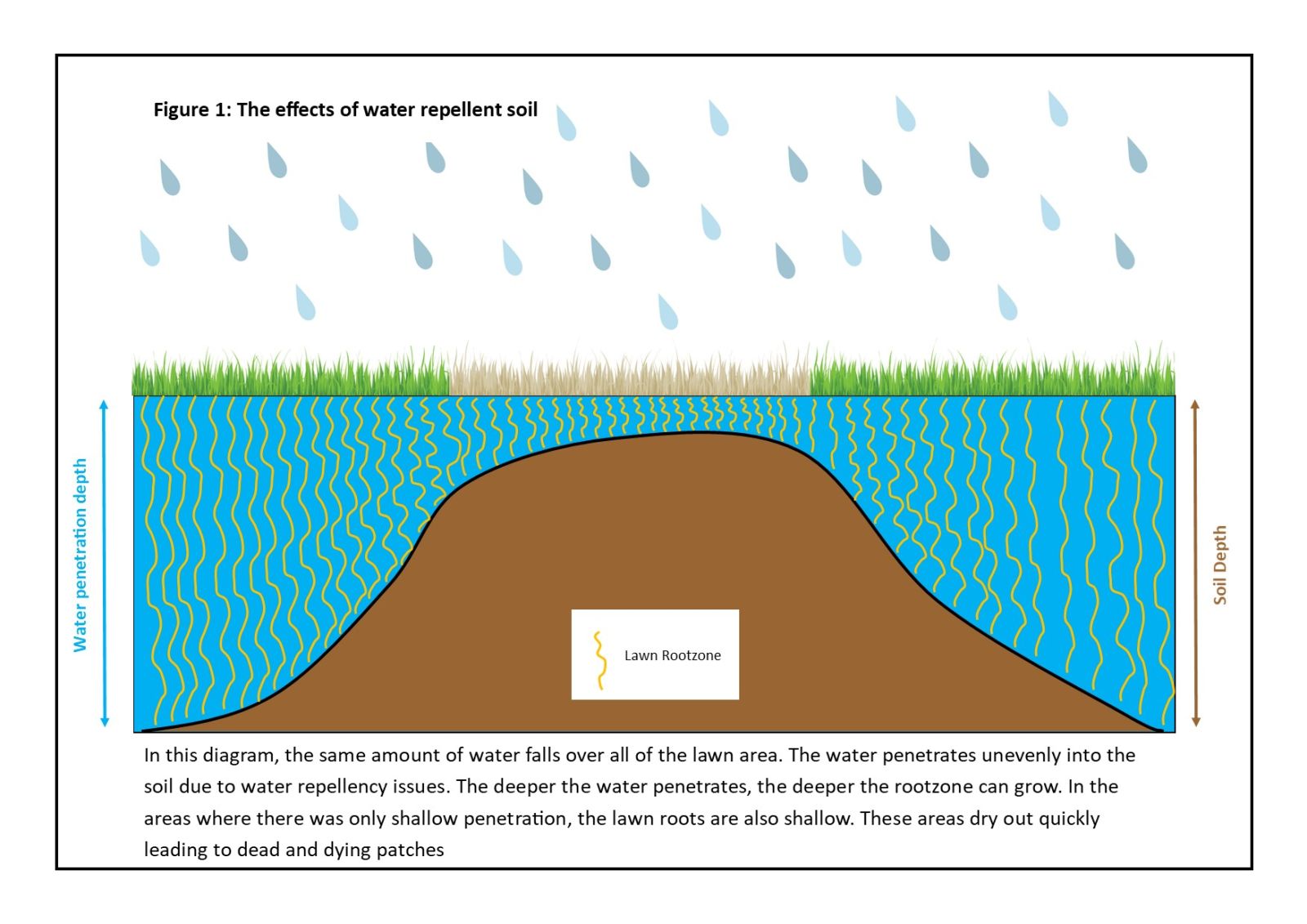
You can be watering enough—but the soil simply isn’t accepting the water.
Non-wetting (or water-repellent) soil occurs when the soil particles develop a waxy coating from organic matter. When that happens, water doesn’t soak in properly. Instead, it sits on the surface, runs off, or evaporates.
So even though you’ve watered, the root zone remains dry—and the lawn shows all the signs of drought stress.
This is particularly common in Adelaide soils once they’ve dried out over summer.
How to tell if you have non-wetting soil
The easiest way to identify it is to water your lawn as you normally would, then go back and dig a small inspection hole in a dry or patchy area. If the soil is still dry just below the surface, the water hasn’t penetrated.
A second way is to compare a core sample from a green area and a brown area. If the green section is moist and the brown section is dry—even though both were watered the same—you’ve found your issue.
You can also try the simple droplet test. Place a drop of water on a dry soil sample. If it beads up or takes several seconds to soak in, the soil is repelling water.
From what we see in-store, around 45% of patchy lawn samples we assess show water-repellent soils. It’s far more common than most people realise.
How to fix it
The solution to non-wetting soil is to help water actually get into the soil profile—and then help it stay there.
The most effective way to do this in a domestic lawn is with a liquid wetting agent. These products break down the waxy coating on the soil and allow water to penetrate evenly into the root zone.
For best results, wetting agents should be applied regularly through the warmer months, not just once. A good rhythm is every six weeks from November through to March.
A simple application looks like this in practice: water your lawn first, apply the wetting agent in the cooler part of the day, then water it in thoroughly so it moves down into the soil profile.
Products like Paul Munns Betta Wet (hose-on) are designed for exactly this purpose and are easy to apply at home.
Once you’ve improved water penetration, you can further improve results by applying a water retention agent such as SST Bi-Agra. While a wetting agent helps water get into the soil, a retention agent helps it stay there longer, reducing stress on the lawn between watering.
A simple starting point
If your lawn is looking patchy this summer, don’t overcomplicate it.
Start by asking:
- Am I actually applying enough water each week?
- Is it being applied evenly?
- Is the soil underneath actually getting wet?
If you’re unsure, applying a wetting agent is often the quickest and most effective first step. In many cases, that single change is enough to turn a struggling lawn around.
FAQs
How much should I water my lawn in summer?
Around 25mm per week for couch and kikuyu lawns is a good guide for maintaining a green, healthy lawn.
Can I water too much?
Yes. Frequent light watering can lead to shallow roots and increase disease risk. Deep, even watering is what you’re aiming for.
Do wetting agents really make a difference?
In South Australian conditions, absolutely. They are one of the most reliable ways to improve water efficiency and lawn performance through summer.
How often should I apply a wetting agent?
Every six weeks through the warmer months for best results.
Is this only for problem lawns?
No. Wetting agents are beneficial for all lawns as they improve water penetration and reduce waste.
Comments (5)
Moss in lawns
By: Nicole on 20 February 2026How can I rid my lawn of moss? Last year I purchased a moss "killer" dry pellet/powder and watered in. The moss is back and the lawn won't grow (couch) even though I have watered well. I have also used wetter. Any suggestions?
Paul Munns Instant Lawn Response
Hi Nicole. The best way to get rid of moss in your lawn is by using a product called Wet and Forget. Its a liquid that you spray on the lawn. There are two versions- a pink solution and a blue solution. Make sure you use the blue version!
Long grass for better water take-up?
By: Kellie on 20 February 2026Hi Stefan Thanks for the informative article. If soil has become water repellent, is there any problem in leaving grass to grow longer (ie, mow higher, or not at all) while you're addressing the soil problem? Or are the roots unlikely to sustain longer grass above the surface?
Paul Munns Instant Lawn Response
The lawn wont mind if you let it grow longer but it will get harder for you to manage. Longer grass generally leads to thatch build up. If thatch gets too high then turf colour tends to be effected. If you have water repellent soil, the best way forward is to treat the soil with wetting agent and continue to mow the lawn at the height you usually keep it at.
Wetting Agent
By: Rennie Williams on 20 February 2026Do I mow the lawn before applying the wetting agent.
Paul Munns Instant Lawn Response
I doesn't make any difference whether you mow first or not as wetting agent is always watered in after application
Lawn - Dry Patches
By: Len Payne on 10 January 2025Thanks Stefan for that very helpful information and solutions. I am a 'sufferer' from 'dry patches' and will follow your great, detailed, advice. I am a regular customer at Paul Munns, so will need to come and see you again!!
Paul Munns Instant Lawn Response
Thanks for the feedback Len! Hopefully you see some improvement in your lawn, if not, give us a call on 8298 0555 so we can help you troubleshoot.
Lawn management
By: Nicole on 10 January 2025Your information on wetting agents is most helpful. However because my lawn was repelling moisture I have the added burden of patches of moss in my couch lawn. Can you advise me please.
Paul Munns Instant Lawn Response
Hi Nicole, thanks for the feedback! We have another blog post that goes into detail about moss removal, see here https://www.paulmunnsinstantlawn.com.au/blog/moss. If you have any questions, please email us on info@paulmunnsinstantlawn.com.au or call on 8298 0555.



